
Berlin Buzzwords team
Berlin Buzzwords is one of Europe’s leading conferences focused on search, data infrastructure, and machine learning—bringing together open source communities and industry practitioners to discuss what’s next in scalable systems.
What We Heard on the Ground
We spent more time listening to attendees, aiming to understand their current search setups and the challenges they faced. In our interactions, it was evident that most organizations attending were using Lucene-based distributions, predominantly Solr, followed by Elasticsearch and OpenSearch. These platforms have significant community know-how, and many attendees were already experimenting with vector search and hybrid search capabilities, though the experiences vary widely.
- Engineers were concerned about integrating dense vector retrieval into existing Lucene-based stacks without driving up index sizes and RAM usage.
- Partial updates remained a recurring frustration: changing a simple numeric field such as price still triggered full-document rewrites despite unchanged vectors.
- Performance tuning had become more complex, especially once reranking layers were added on top of traditional retrieval.
- The boundary between freely available and premium-only capabilities—particularly around features like reciprocal rank fusion (RRF)—was creating architectural confusion.
Vespa's Fit and What Sparked Interest
Vespa has maintained a visible presence at Berlin Buzzwords since 2021, building familiarity among attendees over the years through various talks and production use cases—last year featured Mercari, and this year Climate Radar demonstrated its capabilities.
In our interactions this year, we noticed that while attendees were familiar with Vespa, many had not yet explored its detailed capabilities. The dedicated Vespa booth provided attendees an opportunity to dive deeper, showcasing practical demos such as ColPali for multimodal search and capabilities around e-commerce personalization. During conversations with visitors, we found that Vespa’s native multi-stage reranking, flexible experimentation through ranking profiles, and powerful tensor framework particularly sparked interest with the attendees. These features directly addressed some of the core pain points discussed—such as handling increased index sizes efficiently, managing reranking-induced latency, and simplifying complex experimentation processes—often leaving visitors pleasantly surprised by the possibilities within Vespa.
The Bigger Shift and Where It's Headed
We’re seeing a broader industry shift toward integrated, performant platforms purpose-built for AI-native search workloads. This trend only continues to grow stronger, and Vespa appears well-positioned to support these evolving needs.
At Searchplex, we're already seeing significant interest in multimodal, hybrid search, and personalization use cases—especially within e-commerce and Retrieval-Augmented Generation (RAG) scenarios. More teams are exploring migration to Vespa to gain flexibility and unify relevance, ranking, and retrieval. In that sense, we're here to help companies make that transition to truly AI-native retrieval systems with confidence and clarity. Learn more about our services here.
Marking a Milestone
Lastly, Berlin Buzzwords represented a meaningful milestone for us at Searchplex. While we've quietly focused on helping teams build fast, scalable, and intelligent AI-native retrieval systems, this was the first time we showed up publicly, sporting a tee and with flyers, to share what we do and engage with the community directly.
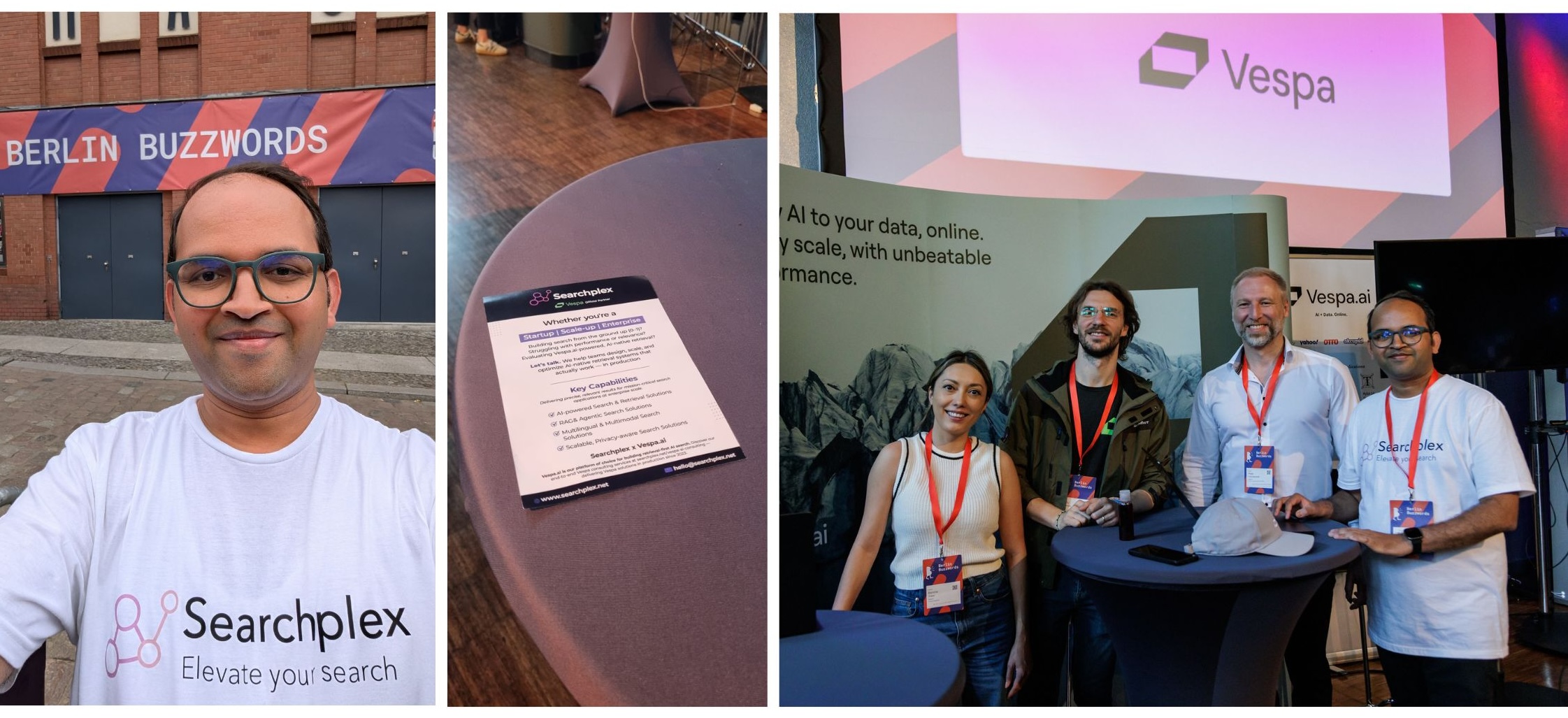
From quiet builders to visible presence.
Pictured here with the Vespa.ai team at their booth (L–R): Bonnie Chase, Radu Gheorghe, Piotr Kobziakowski, and myself.
Photo credit: Berlin Buzzwords team.